The Drexel clinical affiliation agreement, explained
Before your first clinical hour, Drexel and your site need a signed clinical affiliation agreement. CNHP's Contracts and Compliance team runs what Drexel calls the clinical contracting process, NUPR 520 introduces it, and Drexel's Office of General Counsel reviews clinical training agreements. Drexel publishes no current turnaround; an older, non-NP Drexel handbook put it at 3 to 8 weeks.
Get your site contract-ready
Tell us your track, term and the site you have in mind, or ask us to find one. A placement advisor replies with what Drexel will need.
Quick facts
- Who runs it
- CNHP Contracts and Compliance (Clinical Compliance) team
- Legal review
- Drexel's Office of General Counsel
- Where it's introduced
- NUPR 520 Nurse Practitioner Clinical Orientation Seminar
- Current turnaround
- Not published; ask dhcompliance@drexel.edu
- Who signs for the site
- A person authorized to sign legal documents there
What the affiliation agreement is
A clinical affiliation agreement is a contract between two institutions: Drexel and the organization where you will train. You are not a party to it, but it governs you. According to Drexel's compliance FAQ, the contracts it holds with sites are the reason students renew immunizations, CPR certification and background checks each year, and its immunization rules add any extras "required by executed clinical affiliation agreements."
The agreement is also where liability sits. Drexel's general counsel lists students in the university's healthcare programs among those covered by its medical professional liability self-insurance trust. The older non-NP handbook added that the contract itself states Drexel provides the student's malpractice coverage at the site. The trust's limits aren't posted, and a site wanting a coverage certificate asks for one through the department administrator.
Who handles it at Drexel
CNHP's Clinical Compliance team, which also goes by the Contracts and Compliance team, owns the clinical contracting process. Its leadership title, Associate Director of Clinical Compliance and Contract Operations, shows that contracts and clearance live in one office. NP and MSN students have a compliance coordinator there, and doctoral students have a contracts and compliance coordinator. The shared inbox is dhcompliance@drexel.edu.
Legal review happens in Drexel's Office of General Counsel, whose remit covers every clinical training affiliation agreement and student placement agreement for CNHP and the other health units. So when a site sends back its own contract language, expect legal review on Drexel's side as well as the site's.
You meet the process formally in the NUPR 520 orientation seminar, which introduces contracting alongside compliance. For everyone else involved, see who does what.
What the site needs to give Drexel
Drexel's current pages name the preceptor's documents: a CV, state license and board certification. The contract itself depends on a few practical answers from the site. Get them when the preceptor agrees, not weeks later:
- Does the organization already hold an active agreement with Drexel covering nurse practitioner students?
- If not, will it sign Drexel's agreement, or does it require its own student rotation contract?
- Who is authorized to sign legal documents for the hospital or practice, and how is that person reached?
- Does the agreement cover one location, or every clinic and hospital where the preceptor sees patients?
- Does the site run its own student onboarding, such as an application portal, badge or orientation, once the contract is signed?
The second and third questions come straight from Drexel's older handbook, which told students to find out whether a site would sign Drexel's contract or had its own. They remain the questions that decide how long a contract takes.
How an older Drexel handbook described the paperwork
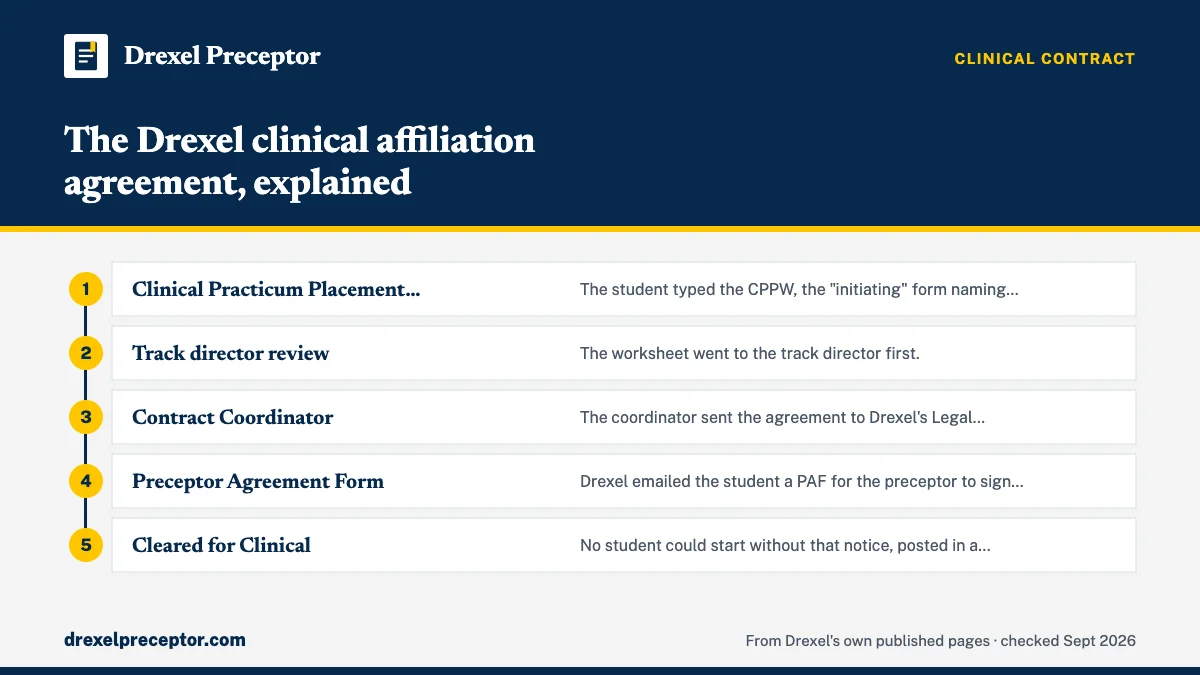
The only detailed public description of Drexel's contract chain is in the 2016–17 clinical handbook for the MSN Advanced Role tracks, a non-NP document. It explains the logic well, but form names and routing may have changed since. It described five steps:
- Clinical Practicum Placement WorksheetThe student typed the CPPW, the "initiating" form naming the preceptor and the site's legal signer, and uploaded it with the preceptor's CV.
- Track director reviewThe worksheet went to the track director first.
- Contract CoordinatorThe coordinator sent the agreement to Drexel's Legal Department and the Dean's Office for signature, on average in 3 to 8 weeks.
- Preceptor Agreement FormDrexel emailed the student a PAF for the preceptor to sign six weeks before the rotation.
- Cleared for ClinicalNo student could start without that notice, posted in a Blackboard Learn clinical paperwork shell.
That handbook also required a separate worksheet when a preceptor saw patients at both an office and a hospital. None of these forms appears on Drexel's current pages, and Blackboard Learn Original courses become read-only on December 31, 2026, as Drexel moves to Canvas. Ask in NUPR 520 for today's submission route and form names.
How Philadelphia-area systems treat agreements
Large health systems often set the pace. The Children's Hospital of Philadelphia requires an agreement that stays current past your rotation dates, accepts graduate requests from a school coordinator rather than from students, and bars students from approaching its preceptors on their own. ChristianaCare requires a current agreement for every nursing student, says it is not entering new ones, and lists Drexel among its graduate clinical partners, so confirm with Drexel that the agreement is active before you contact it.
Virtua lists Drexel as an affiliate school on its individual student request form and asks that the agreement be confirmed before placement is considered. Main Line Health and Penn Medicine also describe affiliation agreements as a condition of graduate rotations. System-by-system details are on Philadelphia clinical sites and New Jersey and Delaware sites.
Planning when the turnaround isn't published
Because Drexel gives no current contract timeline, use the older handbook's 3 to 8 weeks as a rough reference rather than a promise, and start the moment a preceptor agrees. A site with an active Drexel agreement may move faster; a system that insists on its own contract language adds legal review on both sides.
Send Clinical Compliance the site's exact legal name, address and signing contact in one message, and ask whether an agreement is already on file. Then keep the contract moving in parallel with your own clearance items in CastleBranch, since both must be finished before the term's first clinical day. The clinical timeline shows where this fits.
An agreement with the office where your preceptor works may not cover their hospital shifts. Ask about every location where you will see patients.
Why students bring us in before the contract stage
Contract delays usually start with missing facts: the wrong legal name, no named signer, a site that needed its own agreement and nobody asked. We collect those details as part of every Drexel placement. Along with a preceptor who meets Drexel's rules, you get the site's signing contact, its position on Drexel's agreement versus its own, the locations to be covered and the site's onboarding steps.
That package goes to Clinical Compliance complete, so the contracting process can start on day one. Drexel and the site sign the agreement; our part is making sure what lands on Drexel's desk is accurate and rule-ready. If a preceptor falls through after the contract is underway, we're on call with a new search, ideally aimed at a site that already holds a Drexel agreement. See how it works.
Questions Drexel students ask
How long does Drexel take to set up a clinical contract?
Drexel does not publish a current turnaround. The only figure on record is from a 2016–17 handbook for non-NP Advanced Role tracks, which gave an average of 3 to 8 weeks. Sites that require their own contract language can add legal review on both sides, so start as soon as your preceptor agrees and ask Clinical Compliance for status updates.
Does my preceptor sign the affiliation agreement?
Only if they are also the person authorized to sign legal documents for the organization, which can happen at a small practice. The agreement is between Drexel and the site, not the individual clinician. In the older Drexel handbook, the preceptor signed a separate Preceptor Agreement Form instead, so ask in NUPR 520 whether a current preceptor form exists.
What if my clinical site already has a contract with Drexel?
Then the contracting step may be quick, but confirm it rather than assume. Ask Clinical Compliance at dhcompliance@drexel.edu whether an active agreement covers NP students at that exact location and through your rotation dates. ChristianaCare, for example, lists Drexel as a graduate clinical partner and asks students to verify the agreement with their school first.
Can I start seeing patients before the agreement is signed?
No. Drexel ties your clinical start to compliance clearance, and health systems such as CHOP and Main Line Health require the agreement before any student rotates. Even if your preceptor is ready and eager, wait for Drexel's confirmation that the contract is in place and that you are cleared for the term.
Does Drexel provide malpractice coverage for NP students at the site?
Yes, according to Drexel's general counsel: students in its healthcare programs fall under the university's medical professional liability self-insurance trust. That page gives no limits. A site needing proof can request a certificate through the department administrator, and nothing current from Drexel asks NP students to carry a personal policy of their own.
Related pages
Last checked 2026-09-24
We check these pages against Drexel's own sources. Your track director, the CNHP Clinical Compliance team and Drexel's current catalog have the final word.
Hand us the search. Keep your clinical quarter.
Tell us your Drexel track, where you live and which quarter your next clinical course starts. We find a preceptor and site that fit Drexel's rules for your track, and get the contract and compliance details ready early.
- Matched to your track's population, setting and hours
- Checked against Drexel's preceptor rules before anything is submitted
- Planned across the Fall 2027 switch to semesters
Start your placement plan
A placement advisor replies with what a Drexel-ready preceptor and site look like for you.