Preceptors for Drexel's online AGPCNP
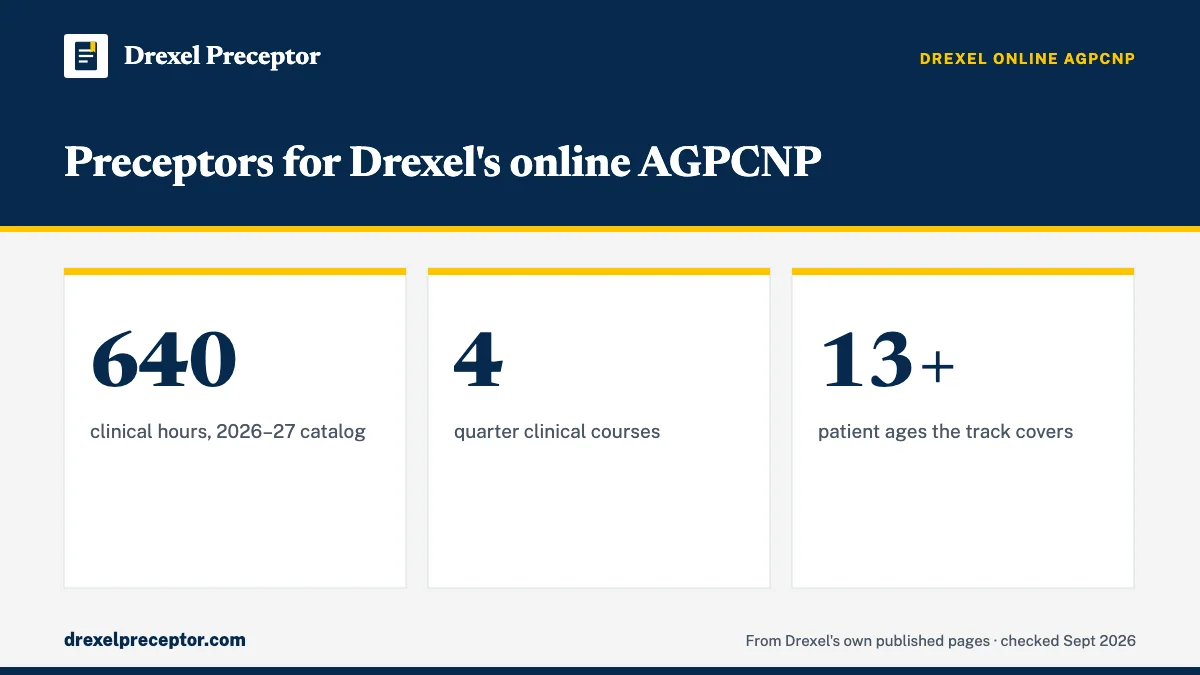
Drexel's online Adult-Gerontology Primary Care NP needs 640 clinical hours over four quarter courses, NURS 660 to NURS 663, in what Drexel calls a mixed outpatient experience: primary care offices, specialty clinics and assisted living. Your patients range from age 13 to the oldest adults. You line up the preceptors, and the later courses lean heavily on geriatric and long-term care.
Plan your Drexel AGPCNP preceptors
Tell us your state and which adult-gero course comes next. A placement advisor replies with primary care and geriatric preceptors that fit Drexel's rules.
Quick facts
- Settings
- Primary care, specialty clinics and assisted living
- Population
- Patients aged 13 years and above
- On-campus intensive
- 4 days, week one of summer, in
NURS 660 - Semester courses
NURS 7600,NURS 7601,NURS 7602andNURS 7603
How Drexel's AGPCNP is organized
The AGPCNP is an online program with residency, taken part-time; most students finish in about three years, by Drexel's estimate. It totals 52.0 credits and 640 clinical hours on the quarter system, and 43.0 credits once the semester version takes over. You can start in Winter 2027 (January 4) or Fall 2027 (August 23). Drexel prefers a year of adult nursing experience but does not require it.
Clinicals open on campus: NURS 660 begins with four days of intensive sessions during the first week of the summer quarter. After that the work happens near home with preceptors you recruit, supported by what Drexel calls resources to assist, including its clinical placement manager and Dragon Network.
Eleven states are closed to new AGPCNP students: Nebraska, the Dakotas, Wyoming, Colorado, Kansas, Missouri, Minnesota, Oregon, Louisiana and Alabama. New York residents may enroll, provided every clinical hour takes place in another state. The approval Drexel holds from Washington's nursing commission extends to the AG Primary MSN. State authorization covers the full picture, including what happens if you move.
The four AGPCNP clinical courses
Drexel publishes the 640-hour total but not a figure for each course. With four 5.0-credit clinical courses, 160 each is the working assumption; your syllabus confirms it. Drexel AGPCNP clinical courses carries the titles and descriptions in full.
| Course | Focus | Hours | Sample-plan quarter |
|---|---|---|---|
NURS 660 AGPC I | Introduction and care of the young adult (OCI) | 160 (derived) | Summer, year 2 |
NURS 661 AGPC II | Adult patients in primary care | 160 (derived) | Fall, year 3 |
NURS 662 AGPC III | Older adults in primary and long-term care | 160 (derived) | Winter, year 3 |
NURS 663 AGPC IV | Gerontology management and care | 160 (derived) | Spring, year 3 |
NURS 660 has a prerequisite chain: B grades or higher in the MSN core and in pathophysiology, pharmacology, health assessment and NURS 664, plus the adult-gero pharmacology course NURS 641. NUPR 520, the clinical orientation seminar, sits about three quarters earlier in the sample plans.
Preceptors and settings for adult-gero primary care
The department's preceptor standard reads the same for every NP track. The clinician is an NP, a CNM or a physician from a specialty the department has approved; holds the license and certification their state demands; is board certified now; and has practiced a year or longer. For this track Drexel Online adds that supervised hours happen alongside licensed physicians and APNs working in accredited institutions. In practice that points to adult-gerontology or family NPs, internists and geriatricians.
Drexel describes the settings as primary care and assisted living, ranging from specialty clinics to primary care offices. The course sequence tells you when each fits: a general adult practice for NURS 660 and NURS 661, then settings that see many older adults for NURS 662, whose description names primary and long-term care, and NURS 663, which is devoted to gerontology.
PAs fall outside Drexel's preceptor standard. Whoever agrees to take you forwards a CV and credential copies to Drexel, and later completes your midterm and final evaluations in E*Value. The shared rules are on Drexel preceptor requirements.
Where AGPCNP searches get hard
The geriatric half is the harder half. Plenty of adult practices take students, but fewer clinicians follow patients into assisted living or long-term care, and those facilities answer to their own rules. Pennsylvania's Older Adults Protective Services Act treats clinical-rotation students as employees of long-term care facilities, personal care homes, home health agencies and adult day centers, which brings a state police check from within the past year and, for recent arrivals, an FBI check.
Large systems narrow things further. UPMC's advanced practice office declines to help place students in geriatrics, internal medicine or family medicine, and Penn State Health serves its own students first. Community practices and physician-led geriatric groups tend to answer faster.
Certificate students carry one extra rule: according to Drexel's AGPCNP certificate page, those 640 hours belong either in the state you live in or in Pennsylvania, and you need a Pennsylvania RN license in addition to your home license. Pennsylvania NP clinical rules explains the state's side.
Plan the older-adult courses early. NURS 662 and NURS 663 need geriatric and long-term care exposure, and clinicians who round in assisted living are far fewer than general adult preceptors.
The semester change for AGPCNP students
Drexel's final quarter-system summer, June 21 to August 7, 2027, is a seven-week term that runs only once. The quarter sample plan starts NURS 660 and its four-day intensive in that season, and Drexel has not yet said how the course fits a shortened term. Ask your advisor before a preceptor reserves those weeks.
From Fall 2027 the AGPCNP shares three clinical courses with the FNP, NURS 7600, NURS 7601 and NURS 7602, then finishes with NURS 7603, Comprehensive Primary Care Review and Clinical Immersion for the AGPCNP, described as advanced clinical immersion within a selected specialty. Because the NURS 7600 description mentions gender-related primary care, ask whether its hours call for any women's health exposure.
The semester MSN catalog prints no clinical hours, though the semester certificate's admissions text still says 640. Semesters open August 23 and run about 14 weeks. The semester switch has the dates.
Why Drexel AGPCNP students choose us
We plan AGPCNP placements from the geriatric end backward. A placement advisor secures the older-adult and long-term care preceptors your last two courses need, then fills the earlier adult primary care quarters around them, all near home. Each NP or physician's credentials, board status and practice history are verified against Drexel's standard before you contact them.
Facility sites get the same care: preceptor credentials and CV, the facility's signer for Drexel's affiliation agreement, and extras such as Pennsylvania's long-term care background checks. Drexel holds the approval, and everything it receives from us arrives complete and within its rules. Should a preceptor leave partway through a quarter, we reopen the search at once. Send us your county and next course on the form below; the steps are set out in how it works.
Questions Drexel students ask
Can I use an assisted-living facility for Drexel AGPCNP hours?
Yes, assisted living appears on Drexel's own settings list for this track. The preceptor still has to be an NP, CNM or physician who clears Drexel's standard, and the facility needs a clinical affiliation agreement with Drexel. In Pennsylvania, expect the facility to apply the state's older-adult protection checks to you as a clinical student.
Where must AGPCNP certificate students complete their hours?
Drexel's AGPCNP post-master's certificate page limits the 640 clinical hours to your home state or Pennsylvania, and requires a Pennsylvania RN license along with your home license. The rule appears only on the certificate page, so confirm it with your advisor if you are thinking of rotations in a third state.
Do specialty clinic hours count in Drexel's AGPCNP?
Drexel describes the AGPCNP clinical experience as ranging from specialty clinical settings to primary care, so specialty clinics fit the track. It does not publish a cap on specialty hours. The semester NURS 7603 course is built around immersion in a selected specialty. Ask your track director how many specialty hours each course accepts.
What life support certification do AGPCNP students need?
Every Drexel clinical student needs American Heart Association BLS, and cards marked BLS RQI are fine. Drexel ties ACLS to the acute care tracks and PALS to the pediatric ones, so neither is named for adult-gero primary care. Upload your card to CastleBranch and renew before it lapses mid-sequence.
Can I do Drexel AGPCNP clinicals where I live?
In most states, yes, provided you do not live in one of the eleven states Drexel cannot admit NP students from and your clinicals are outside New York. You need an RN license valid for the clinical state, and Drexel's pages disagree on whether a Pennsylvania license is also required. Moving mid-program can affect your clinicals.
Related pages
Last checked 2026-09-24
We check these pages against Drexel's own sources. Your track director, the CNHP Clinical Compliance team and Drexel's current catalog have the final word.
Hand us the search. Keep your clinical quarter.
Tell us your Drexel track, where you live and which quarter your next clinical course starts. We find a preceptor and site that fit Drexel's rules for your track, and get the contract and compliance details ready early.
- Matched to your track's population, setting and hours
- Checked against Drexel's preceptor rules before anything is submitted
- Planned across the Fall 2027 switch to semesters
Start your placement plan
A placement advisor replies with what a Drexel-ready preceptor and site look like for you.