How our placement service works, in Drexel's own order
We work in the order Drexel does. First your track and the quarter your next clinical course opens, then a preceptor and site who fit that course, then the details Drexel's contracting and compliance teams ask for, then steady support until your hours are validated in E*Value.
Start with your track and quarter
Tell us your Drexel track, your next clinical course and where you live. A placement advisor replies with a plan.
Quick facts
- Who gives final approval
- Drexel, for each preceptor, site and agreement
- Where you train
- In person, within reach of where you live
- Documents we gather
- Preceptor CV, license, board certification, site contact
- If a preceptor drops
- Your placement advisor starts the replacement search
Stage 1: your track, your next course and your quarter
Every search starts with three facts: your Drexel track, the clinical course you take next and the quarter it opens. An FNP student heading into NURS 534 needs a family practice preceptor who sees patients across the lifespan. An AGACNP student starting NURS 570 needs medical, surgical or critical care. A PMHNP student entering NURS 592 needs psychiatric care, and a WHNP student in NURS 690 needs women's health and gender-related care.
We also ask where you live and how far you can drive on clinical days. Drexel admits NP students from most states but not all of them, and New York is off the table for clinical rotations, so your address shapes the map before the first call goes out. Drexel's state authorization rules set out the details.
If your clinical courses fall after the switch, we plan with the semester numbers in the 2027–28 catalog as well, such as NURS 7600 for FNP and NURS 7500 for AGACNP. The semester switch explains how the numbers change.
Stage 2: a search built on Drexel's preceptor rules
Drexel's list is short and specific: NPs, certified nurse midwives, and physicians whose specialty Drexel approves. Each must hold the license and certification their state requires, be board certified today and have a full year of practice behind them. We screen for all of that before a name ever reaches you, so every preceptor you hear about already qualifies.
Then we match the clinical setting to your course. AGPCNP hours belong in primary care and assisted living. Emergency hours happen in urgent care centers, EDs, and trauma or critical care units. Pediatric tracks need pediatric patients, in primary care or acute care depending on the course in front of you.
We search in person, close to you: clinics and hospitals you can reach on a clinic-day commute, with schedules that fit a ten-week quarter. When a candidate agrees, you get their details and a clear picture of the days they can offer. Drexel's preceptor requirements covers the rules in full.
Stage 3: contract and compliance details, ready early
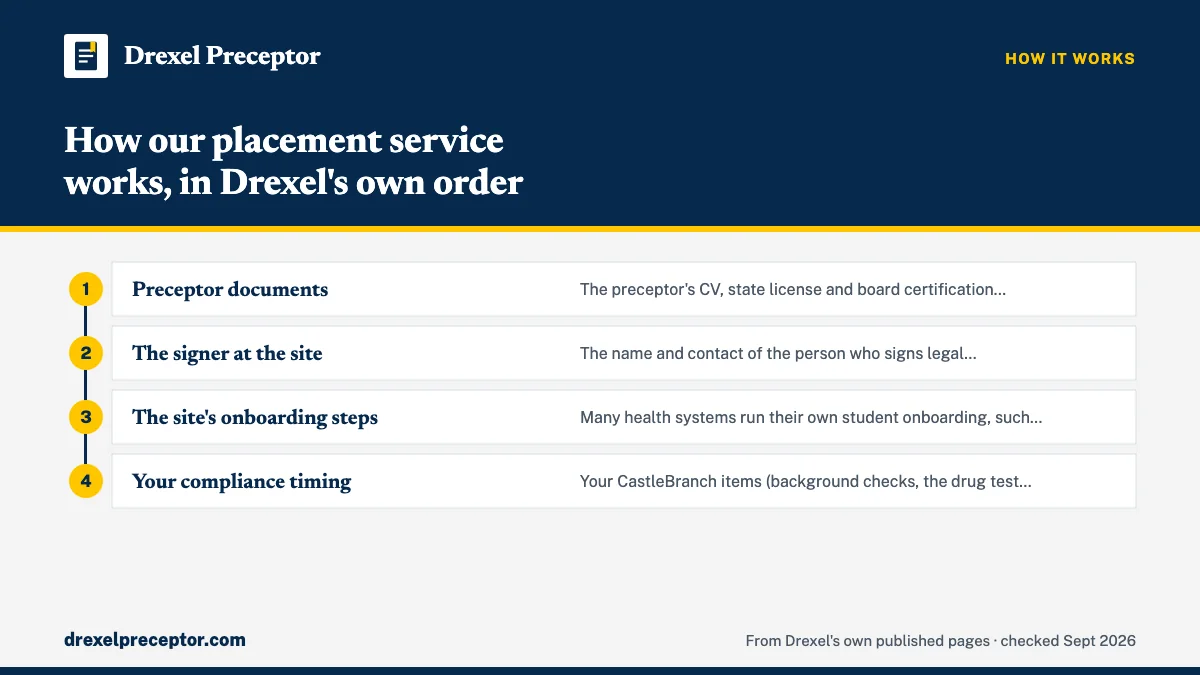
Drexel's clinical contracting process, introduced in NUPR 520, turns a willing preceptor into an approved placement. We assemble the pieces that process depends on, so nothing waits on a missing detail:
- Preceptor documentsThe preceptor's CV, state license and board certification, the three items Drexel asks every preceptor to supply.
- The signer at the siteThe name and contact of the person who signs legal agreements for the practice or hospital, so CNHP's Contracts and Compliance team can put a clinical affiliation agreement in place.
- The site's onboarding stepsMany health systems run their own student onboarding, such as badge requests, orientation modules or an online placement platform. We find out what applies and when it is due.
- Your compliance timingYour CastleBranch items (background checks, the drug test, immunizations, BLS) are yours to complete. We line the site's needs up with your clearance dates so both finish together.
Each of those three, preceptor, site and contract, gets Drexel's sign-off. Our part is making sure the file you hand Drexel is complete and matches its rules on the first pass. The affiliation agreement page covers the contract itself.
Agreement from a preceptor is step one of several: the site still needs a signed affiliation agreement with Drexel before your first clinical day.
Stage 4: your hours, through the final validation
Once the quarter opens, E*Value is where your preceptor records two evaluations of you, one at midterm and one at the end, and signs off on your hours. Many Drexel clinical courses carry 160 hours, and Drexel's AGACNP page describes a typical week as two eight-hour clinical days, so a schedule that slips by even one week matters.
Your placement advisor stays reachable for the whole quarter. If a preceptor has to step away, you tell us and the replacement search starts straight away, with the same checks against Drexel's rules. If your preceptor drops out walks through protecting the hours you have already logged.
Summer 2027 lasts just seven weeks while Drexel changes calendars, and summer is where Drexel's plans of study usually start the first clinical course. If yours falls there, we plan preceptor days with that shorter window in mind.
When to bring us in
Earlier is better. Drexel publishes no date for submitting a site or preceptor, and its plans of study schedule NUPR 520 roughly three terms ahead of your first clinical course, making that seminar the natural moment to start the search.
Compliance runs on its own clock. Drexel warns that finishing the Hepatitis B series may take as long as seven months, and students are cleared for a clinical term only when documents arrive by the dates their compliance coordinator sends. Starting the preceptor search alongside those items keeps one from holding up the other.
Already close to your quarter? Reach out anyway and put the timing in your first message. Need a preceptor fast sorts the next steps by the weeks you have left.
Working with a placement advisor
One placement advisor follows your placement from the first message to your last validated hour. You can reach them through the form, the chat or text, and every decision is written down so you can check it later.
Before any search begins you receive a written quote and terms, and you take whatever time you need to decide. The cost page breaks down how each quote is put together.
What you get at each stage
- A plan that names your course, your quarter and the setting your track calls for
- Candidates vetted on Drexel's criteria first, so only qualified names reach you
- The preceptor documents and site contact Drexel's contracting team needs
- Updates while candidates are checked, and a fast restart if one steps away
Questions Drexel students ask
Which Drexel programs do you help with?
Every online NP track: FNP, FNP with Emergency Specialization, AGACNP, AGPCNP, PMHNP, the three pediatric options, WHNP and the Emergency/Trauma certificate, plus the matching post-master's certificates. We also help post-master's DNP students look for a doctorate-prepared practicum mentor, and MSN Nursing Education, Leadership and RN-to-BSN students with their practicum or clinical hours.
I already found a preceptor. Can you still help?
Yes. We check that preceptor against Drexel's list and your track's setting, gather the CV, license and board certification, and pin down who signs agreements at the site. If the preceptor can cover only part of your hours, we search for a second one to fill the rest of the course.
Who submits my placement to Drexel?
You do, through the route your NUPR 520 seminar and your compliance coordinator describe. Drexel's current submission forms are not posted publicly, so follow their instructions exactly. We make sure every detail they ask for about the preceptor and the site is ready and accurate before it goes in.
How long does a preceptor search take?
It depends on your track, your location and how soon the quarter opens. A family practice preceptor near a city with many clinics is a narrower task than a pediatric acute care or emergency preceptor in a rural county. Your placement advisor gives you a realistic read in the first conversation, based on your course and your map.
Do I have to live near Philadelphia?
No. Drexel's NP programs are online, so you train where you live and we search there. Drexel cannot presently enroll NP students who live in eleven states, and New Yorkers do their clinical hours in a neighboring state; the state authorization page names each one and explains the rules behind them.
Related pages
Last checked 2026-09-24
We check these pages against Drexel's own sources. Your track director, the CNHP Clinical Compliance team and Drexel's current catalog have the final word.
Hand us the search. Keep your clinical quarter.
Tell us your Drexel track, where you live and which quarter your next clinical course starts. We find a preceptor and site that fit Drexel's rules for your track, and get the contract and compliance details ready early.
- Matched to your track's population, setting and hours
- Checked against Drexel's preceptor rules before anything is submitted
- Planned across the Fall 2027 switch to semesters
Start your placement plan
A placement advisor replies with what a Drexel-ready preceptor and site look like for you.