How Drexel's NP clinical placement process works
At Drexel, the NP student is the one who locates and lines up a clinical site and preceptor, with help from the graduate nursing department. Around that search sit NUPR 520, a clinical contract between Drexel and the site, compliance clearance in CastleBranch and preceptor evaluations in E*Value. Drexel signs off on every piece; your job is to feed it complete, rule-fitting information early.
Map your Drexel placement path
Tell us your track and first clinical quarter. A placement advisor replies with where you stand and what comes next.
Quick facts
- Who finds the preceptor
- You do, with resources from Drexel's graduate nursing department
- Orientation course
- NUPR 520, taken before your first clinical course
- Site contract
- Affiliation agreement via CNHP Contracts and Compliance
- Clearance system
- CastleBranch, with yearly background and drug screens
- Placement deadline
- None published; your compliance coordinator sends due dates
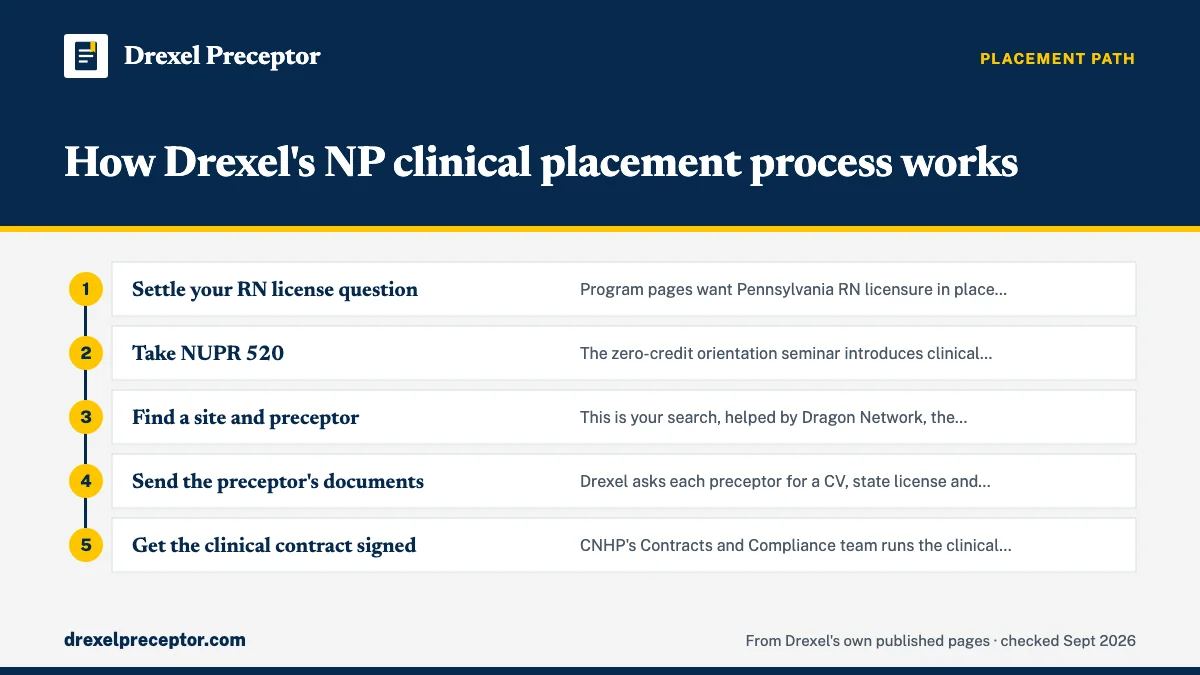
The Drexel path at a glance
Drexel publishes no single flowchart for NP clinical placement, but its catalog, compliance pages and preceptor page describe one consistent sequence. Read it as seven stages. Several overlap in time, and the contract and compliance stages usually run side by side once a preceptor agrees.
- Settle your RN license questionProgram pages want Pennsylvania RN licensure in place before clinical courses, yet the compliance certifications page lets a compact license held in your primary state of residence stand in. Work out which rule covers you on the Pennsylvania license page.
- Take
NUPR 520The zero-credit orientation seminar introduces clinical support services, your track's requirements, contracting and compliance. - Find a site and preceptorThis is your search, helped by Dragon Network, the clinical placement manager's recruiting and your own contacts.
- Send the preceptor's documentsDrexel asks each preceptor for a CV, state license and board certification.
- Get the clinical contract signedCNHP's Contracts and Compliance team runs the clinical contracting process with the site.
- Clear complianceBackground checks, drug screen, immunizations, BLS, training and health insurance go into CastleBranch by your coordinator's dates.
- Complete the rotationYour preceptor validates your hours and files midterm and final evaluations in E*Value.
Stage three is yours: the site and preceptor search
Each current Drexel NP program page that mentions placement assigns the search to the student, and none promises a spot. Drexel does name two forms of help. Dragon Network lets you message Drexel alumni and affiliated clinicians who have signed up to precept, and a clinical placement manager works on recruiting new preceptors for the department. Both are explained on Dragon Network and the placement manager page.
Geography shapes the search. Drexel cautions that site availability differs by state and that some students travel for clinicals. Pediatric applicants get a specific tip: holding RN licenses in Pennsylvania, New Jersey and Delaware widens the pool of sites. And New York residents may enroll in the NP programs, but every one of their clinical hours has to happen outside New York.
What Drexel checks before your first clinical day
Three approvals have to line up before you log an hour. First, the preceptor has to qualify: a nurse practitioner, nurse midwife or physician whose specialty Drexel accepts, credentialed for their state, board certified and past their first year of practice. The detail, including the gaps in Drexel's rules, is on preceptor requirements.
Second, the site and Drexel must sign a clinical affiliation agreement. The CNHP Contracts and Compliance team drives it, with Drexel's legal office reviewing the terms. Timing and paperwork are on the affiliation agreement page.
Third, you must be cleared. Your compliance coordinator issues a list and due dates specific to your program, and a document still missing at the cutoff keeps you out of clinical for that term. Proof of comprehensive health insurance is on the list too. Each item is broken down on clinical compliance.
Treat a preceptor's agreement as the opening move. No hour counts until the site contract is executed and Clinical Compliance has cleared you.
During the rotation: evaluations, faculty and hours
Each Drexel clinical course pairs online class work with the rotation in the same quarter. The load is real. Acute care students, for example, owe 160 hours per clinical course, usually spread over a pair of 8-hour clinic days each week, on top of a required three-hour live class every week.
In E*Value, your preceptor rates your performance at midterm and again at the close of the course, and confirms the hours you logged. They also update your clinical faculty on how you are doing. When the term ends, the preceptor receives Drexel's Certificate of Appreciation showing the hours verified.
One point to confirm: E*Value is the only tracking system on Drexel's current preceptor page, while a 2016–17 handbook for the non-NP Advanced Role tracks used Exxat. Ask in NUPR 520 where you log hours and patient encounters. E*Value at Drexel covers what students see.
What Drexel leaves unpublished, and how to plan around it
Several things students expect to find are missing from Drexel's public pages. There is no deadline for naming a site or preceptor, no current NP clinical handbook, no stated turnaround for affiliation agreements and no rule on telehealth hours. The only detailed paperwork description comes from an older non-NP handbook, which named a Clinical Practicum Placement Worksheet, a Preceptor Agreement Form and a contract time of 3 to 8 weeks. Treat those as history rather than current instructions.
The sample plans are the best guide. They put NUPR 520 roughly three quarters ahead of the first clinical course, which we read as the runway Drexel expects you to need, not a published deadline. Your compliance coordinator's due dates are the ones that bind. Work backward from them with the clinical timeline.
Where the semester switch lands in this path
Drexel moves to semesters in Fall 2027, and the course numbers change with it. The quarter FNP sequence, NURS 534 to NURS 538, turns into four semester courses in the 2027–28 catalog (NURS 7600 to NURS 7602, plus NURS 7604), and every other NP track gets new four-digit numbers too. The semester catalog does not publish clinical hours per course.
The awkward term is Summer 2027. It lasts only seven weeks, June 21 through August 7, as a one-off bridge between calendars. Sample plans put many first clinical courses and their week-one On-Campus Intensives in summer, and Drexel has yet to explain how a 160-hour course fits into seven weeks. If your first rotation falls there, ask your advisor and track director early, and read the semester conversion page.
Why Drexel students choose us for the search
We are built around this exact path. When you send your track, your first clinical quarter and where you live, a placement advisor starts looking for a preceptor and site that fit the course: the right population and setting, enough availability for the hours, and a clinician who meets Drexel's rules on role, board certification and a year in practice. We look for in-person placements close to you.
Then we handle the part that usually stalls students. We gather the preceptor's CV, license and certification proof, identify who signs contracts at the site, and map the site's own onboarding steps, so Clinical Compliance receives a complete file that matches Drexel's rules on the first pass. The approval itself stays with Drexel. Should a preceptor drop out partway through the program, we're on call and searching again right away. See how it works or send your details through the contact page.
Questions Drexel students ask
Does Drexel place nurse practitioner students in clinical sites?
Not according to its current pages. Drexel's NP programs describe self-placement, supported by department tools like Dragon Network and by a placement manager whose job includes recruiting preceptors. The only Drexel nursing program that lists its own clinical sites is the campus-based Nurse Anesthesia DNP, which works on a different model from the online NP tracks.
When do I have to tell Drexel where I'm doing clinicals?
Drexel publishes no fixed deadline for submitting a site or preceptor. What binds you is the checklist your compliance coordinator issues for your program, with its own due dates; late items can keep you out of clinical that term. Since contracts and clearances take time, aim to have a preceptor confirmed well before the quarter your first clinical course begins.
Can I start clinical hours while my paperwork is still pending?
Drexel's compliance pages tie your clinical start to having every document in by the stated dates, and a student lacking comprehensive health insurance stays uncleared. The site's clinical contract also has to be in place. Ask Clinical Compliance to confirm you are cleared before your first shift with the preceptor.
Do Drexel NP students log hours in E*Value or Typhon?
Drexel's preceptor page names E*Value for midterm and final evaluations and for validating your hours. Typhon appears in no Drexel source we reviewed. An older non-NP handbook from 2016–17 used Exxat, so confirm the current system for logging hours and patient encounters during NUPR 520 rather than relying on older guides.
Are clinical courses separate from the online classes?
No. Drexel runs each clinical course's didactic and clinical rotation concurrently, so you attend class and complete hours in the same quarter. Acute care students, for instance, attend a live three-hour class each week while usually working two full clinic days. On-Campus Intensives, where your track has them, sit inside specific clinical courses.
Related pages
Last checked 2026-09-24
We check these pages against Drexel's own sources. Your track director, the CNHP Clinical Compliance team and Drexel's current catalog have the final word.
Hand us the search. Keep your clinical quarter.
Tell us your Drexel track, where you live and which quarter your next clinical course starts. We find a preceptor and site that fit Drexel's rules for your track, and get the contract and compliance details ready early.
- Matched to your track's population, setting and hours
- Checked against Drexel's preceptor rules before anything is submitted
- Planned across the Fall 2027 switch to semesters
Start your placement plan
A placement advisor replies with what a Drexel-ready preceptor and site look like for you.