Pennsylvania rules for Drexel NP clinicals
Drexel is a Pennsylvania school, so its NP programs are Pennsylvania CRNP programs under 49 Pa. Code Chapter 21. The rules that touch your clinicals most set who may precept (§ 21.373), the minimum hours (§ 21.369) and when an RN licensed elsewhere may train in the state (§ 21.118), and a rewrite of the Board's education rules goes before IRRC on October 15, 2026.
Training in Pennsylvania?
Tell us your Drexel track, quarter and county. A placement advisor replies with how we would search Pennsylvania for a preceptor who fits both sets of rules.
Quick facts
- Who may precept
- Licensed APRNs, physicians and certified CRNPs, § 21.373(c)
- Physician assistants
- Not on § 21.373's list or on Drexel's
- Out-of-state RNs
- May train in PA clinicals under § 21.118 while enrolled
- Pending rule
- 16A-5141 at IRRC on October 15, 2026
- Preceptor tax credit
- None found in Pennsylvania
Which Pennsylvania rules apply to you
The Pennsylvania State Board of Nursing sets CRNP program standards in 49 Pa. Code §§ 21.361 to 21.377 and certifies CRNPs under §§ 21.261 to 21.271. The Subchapter C table of contents is current through 56 Pa.B. 4026, published July 4, 2026.
Section 21.361 sets the frame. A CRNP program admits nurses who hold a baccalaureate in nursing, ends in a master's degree or post-master's certificate, and prepares the RN to diagnose and prescribe in collaboration with a physician. Drexel's online MSN and post-master's NP tracks follow that pattern.
Drexel's own rules sit on top of the state's and are often stricter. Where the two differ, Drexel's rule decides your placement, and the sections below explain why a Pennsylvania site may ask for more than the Board does.
Who may precept under § 21.373
Section 21.373(c) names the onsite clinical preceptors a Pennsylvania CRNP program may use: advanced practice nurses who are currently licensed, physicians who are currently licensed, and CRNPs who are currently licensed and certified. The Board's CRNP program checklist, dated May 5, 2025, repeats the same three groups.
Physician assistants are absent. Drexel's list, a nurse practitioner, certified nurse midwife or physician in an approved specialty, fits inside the state's and adds board certification and a year of practice. See Drexel preceptor requirements.
Faculty ratios in § 21.373
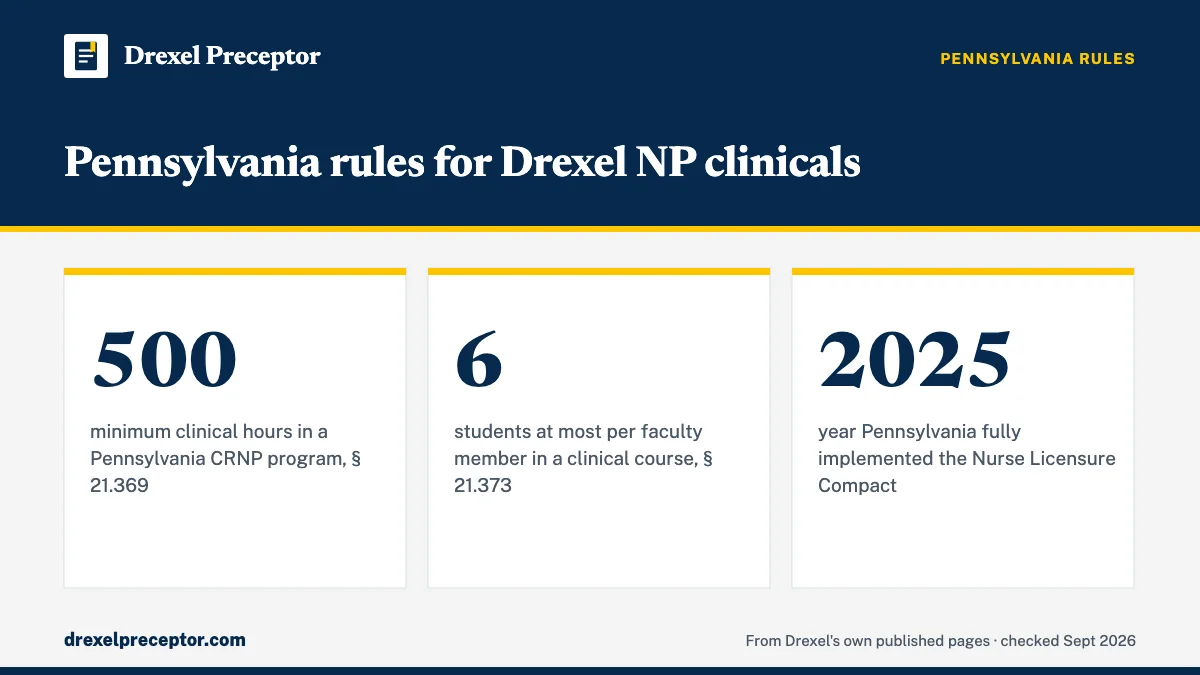
- One program faculty member supervises no more than six students in a clinical course.
- The limit is two students when a faculty member is also the onsite preceptor.
- It is one student when faculty manage their own caseload.
Clinical hours and program standards
Section 21.369 requires clinical hours that meet at least national certification requirements, with a minimum of 500. It also calls for pharmacology as a separate or dedicated 3-credit or 45-hour course. Every Drexel NP track clears the hour floor, from 640 hours in AGPCNP, PMHNP, PNP primary care and WHNP to 1,140 in the FNP with Emergency Specialization, with FNP at 720 and AGACNP and PNP acute care at 800.
The Board's program checklist asks programs to file written agreements or letters of intent for each cooperating agency. That is the state-level root of Drexel's clinical contracting process, the reason every placement needs a signed agreement before your first shift. Track totals are laid out on Drexel clinical hours by track.
Your RN license for Pennsylvania clinicals
Under § 21.118, an RN licensed in another U.S. jurisdiction or Canada who is enrolled in an accredited graduate nursing program may practice in a Pennsylvania clinical setting as the program requires without a Pennsylvania license, provided the only pay is stipends, scholarships or awards. Working as a paid RN in Pennsylvania during the program still needs licensure by endorsement.
Pennsylvania fully implemented the Nurse Licensure Compact on July 7, 2025, so an active, unencumbered multistate license lets you practice there, and the Board says one may meet the RN prerequisite for CRNP certification. Drexel is stricter than § 21.118: its program pages call for a Pennsylvania RN license before clinicals, while its compliance page accepts a multistate license from your primary state of residence. Some sites add their own rule; CHOP asks graduate students for a Pennsylvania or New Jersey license. The conflict is unpacked on the Pennsylvania RN license question.
How your Pennsylvania preceptor practices
A Pennsylvania CRNP diagnoses and prescribes in collaboration with a physician licensed in the Commonwealth (§ 21.251, § 21.282a). Collaboration means a physician immediately available by direct communication or telecommunications, a predetermined plan for emergency services, and scheduled availability for referrals, chart review and consultation, all written into a signed collaborative agreement.
Prescribing adds a prescriptive authority collaborative agreement under § 21.285 that names at least one substitute physician and is reviewed at least every two years. Under § 21.284 a CRNP may prescribe up to a 30-day supply of a Schedule II controlled substance and up to 90 days of Schedule III or IV. No CRNP-per-physician ratio applies now; former § 21.287's four-CRNP limit was deleted in 2009.
For you, those agreements shape what an NP preceptor may do with patients and so what you will see and practice. Full practice authority bills (SB 25 and HB 739) were introduced in 2025, and none had been enacted when this page was checked.
The pending education rule, 16A-5141
The Board's rewrite of its nursing education rules, 16A-5141 (Nursing Education Programs; Terminology Updates), reached the Independent Regulatory Review Commission in final form on September 8, 2026, and IRRC's public meeting on it is set for October 15, 2026. The proposed version, published at 55 Pa.B. 728 in January 2025, would move program rules into a new Subchapter I and would define a clinical preceptor as someone who enhances faculty-directed clinical experiences by guiding selected clinical activities.
IRRC's 2025 comments noted that the proposal would require CRNP faculty to hold or obtain a nursing doctorate and programs to hold programmatic accreditation within five years. A public comment said post-master's clinical hours would rise from 540 to 750, which the rule text did not confirm, and the final text had not been reviewed when this page was written.
In the same proceeding the Board declined to regulate out-of-state schools that place students in Pennsylvania, saying it lacks statutory authority over them. Since Drexel is a Pennsylvania program, the practical effect is competition: online students from other states can seek the same Pennsylvania sites. Ask your track director whether the final rule changes anything for your cohort.
Clearances and preceptor incentives
Pennsylvania sites expect three clearances, and Drexel orders them through CastleBranch: a Pennsylvania State Police criminal record check, a Pennsylvania Child Abuse History Clearance and FBI fingerprints. State rules renew them at least every 60 months, while Drexel's agreements with sites call for background checks every year.
The Older Adults Protective Services Act reaches further in long-term care, home health and similar facilities. Its regulations count a student doing a clinical rotation as an employee who needs a state police report from within the past year, plus an FBI report if they have not lived in Pennsylvania for the prior two years. The steps are on Drexel background checks and clearances.
No Pennsylvania preceptor tax credit, bill or program turned up in research, and the federal PRECEPT Nurses Act remains a bill. What Drexel offers preceptors is recognition: the Clinical Faculty title, a certificate of hours each term and a Drexel continuing education discount.
How we handle Pennsylvania placements
Pennsylvania placements reward precision. We check that every preceptor we propose fits both § 21.373 and Drexel's stricter list, collect the CV, license and board certification Drexel asks for, and hand over the site's contact for the affiliation agreement so contracting can begin straight away.
We flag clearance needs early too, including OAPSA settings, so your CastleBranch file matches what the site expects. Drexel approves every preceptor, site and agreement, and what we send is built to clear its review the first time. If a Pennsylvania preceptor drops mid-quarter, we are on call with a replacement who meets the same tests. For systems in and around the city, see Philadelphia clinical sites, then tell us your track and county through the request form.
Questions Drexel students ask
Can a physician assistant precept an NP student in Pennsylvania?
Not under Pennsylvania's CRNP program rule. 49 Pa. Code § 21.373(c) lists licensed advanced practice nurses, licensed physicians and licensed, certified CRNPs as onsite preceptors, and physician assistants are not included. Drexel's own list of nurse practitioners, certified nurse midwives and physicians in an approved specialty leaves them out as well.
Do I need a Pennsylvania license to do NP clinicals in Pennsylvania?
State law is looser than Drexel. § 21.118 lets an RN licensed in another state who is enrolled in an accredited graduate program train in Pennsylvania clinicals without a Pennsylvania license, and a multistate compact license has worked there since July 2025. Drexel's pages ask for a Pennsylvania license or, on the compliance page, a multistate one, so follow Drexel.
What is Pennsylvania rulemaking 16A-5141?
It is the State Board of Nursing's rewrite of its nursing education program rules, titled Nursing Education Programs; Terminology Updates. The final-form rule reached IRRC on September 8, 2026, and the public meeting is October 15, 2026. The proposal touched CRNP faculty credentials and program accreditation; check the final text for any effect on clinical hours.
Does Pennsylvania give preceptors a tax credit?
No Pennsylvania preceptor tax credit, bill or law turned up in research for this page, although the legislature's bill search could not be reached for a final check. A federal bill, the PRECEPT Nurses Act, would create a credit but is not law. Drexel recognizes its preceptors with a Clinical Faculty title, an hours certificate and a CE discount.
How many clinical hours does Pennsylvania require for NP programs?
Section 21.369 requires clinical hours that meet at least national certification requirements, with a minimum of 500. Drexel's tracks exceed that: 640 hours in AGPCNP, PMHNP, PNP primary care and WHNP, 720 in FNP, and 800 in AGACNP and PNP acute care. A proposed increase for post-master's students was reported in 2025 but not confirmed.
Related pages
Last checked 2026-09-24
We check these pages against Drexel's own sources. Your track director, the CNHP Clinical Compliance team and Drexel's current catalog have the final word.
Hand us the search. Keep your clinical quarter.
Tell us your Drexel track, where you live and which quarter your next clinical course starts. We find a preceptor and site that fit Drexel's rules for your track, and get the contract and compliance details ready early.
- Matched to your track's population, setting and hours
- Checked against Drexel's preceptor rules before anything is submitted
- Planned across the Fall 2027 switch to semesters
Start your placement plan
A placement advisor replies with what a Drexel-ready preceptor and site look like for you.