Drexel PNP clinical courses: primary care, acute care and dual
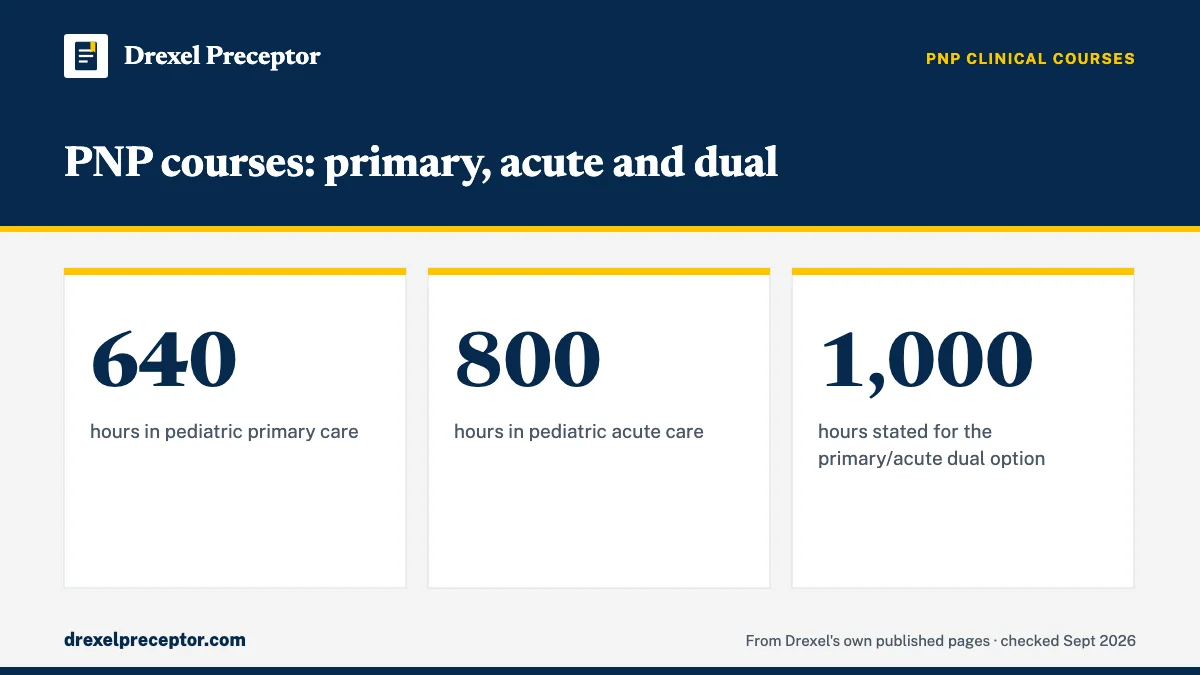
Drexel's three pediatric NP tracks share a two-course primary care foundation, NURS 642 and NURS 643, then split. Primary care finishes with NURS 647 and NURS 648 for 640 hours, acute care adds NURS 649 to NURS 651 for 800, and the dual option takes six courses for the 1,000 hours its catalog entry states. For these tracks Drexel publishes program totals only, with no per-course figure.
Planning pediatric rotations?
Tell us your pediatric track, your next course and your region, and a placement advisor will look for a pediatric preceptor who fits.
Quick facts
- Shared first courses
NURS 642andNURS 643in all three pediatric tracks- Track pharmacology
NURS 646, with a B or better beforeNURS 642- Life support
- PALS, listed by Drexel for pediatric NP students
- Licenses Drexel suggests
- Pennsylvania, New Jersey and Delaware
- Dual option status
- Winter 2027 start only; absent from the 2027–28 catalog
Three tracks, one shared start
All three pediatric tracks open with the same two primary care courses in Summer of year two and Fall of year three. After that, the sample plans diverge: primary care stays in the office, acute care moves into acute and chronic illness management, and the dual option does both, adding a fourth year.
| Course | Title | Primary care | Acute care | Dual |
|---|---|---|---|---|
NURS 642 | PNP I: Primary Care of Infants, Children and Adolescents | Summer, yr 2 | Summer, yr 2 | Summer, yr 2 |
NURS 643 | PNP II: Episodic Care of Infants, Children and Adolescents in Primary Care | Fall, yr 3 | Fall, yr 3 | Fall, yr 3 |
NURS 647 | PNP III: Management and Care of Adolescents in the Primary Care Setting | Winter, yr 3 | Not taken | Fall, yr 4 |
NURS 648 | PNP IV: Primary Care of Children with Special Health Care Needs | Spring, yr 3 | Not taken | Not taken |
NURS 649 | Pediatric NP Acute Care I: Acute-Chronic Care of Infants, Children and Adolescents | Not taken | Winter, yr 3 | Winter, yr 3 |
NURS 650 | Pediatric NP Acute Care II: Acute-Chronic Care of Infants, Children and Adolescents | Not taken | Spring, yr 3 | Spring, yr 3 |
NURS 651 | PNP Management of the Medically Fragile and Technology Dependent Child in the Community | Not taken | Summer, yr 3 | Summer, yr 3 |
| Total hours | Program totals from the catalog | 640 | 800 | 1,000 |
Every course carries 5.0 quarter credits, inside MSNs of 52.0 credits for primary care, 57.0 for acute care and 62.0 for the dual option. The clinical hours overview compares these totals with the other Drexel tracks.
Hours per course, and the dual-option question
No pediatric course description states an hour count. For primary care, 640 over four courses gives 160 each, and for acute care, 800 over five gives the same 160; both are derived figures, consistent with the per-course hours Drexel states for FNP and WHNP.
The dual option does not divide cleanly. Its catalog entry states 1,000 clinical hours over six courses, but six courses at 160 would make 960, and no split is published. The option also looks different from the other two in the admissions calendar: it averages four years, Winter 2027 is its only listed MSN start, the certificate version lists no start term, and it is missing from the 2027–28 semester catalog. Ask the program about its future before you enroll, and ask your track director how the 1,000 hours are divided before you plan preceptors.
Dual-option students: get the per-course hour split from your track director in writing before your first acute care quarter.
Settings each pediatric course points to
The course titles map fairly clearly onto settings. NURS 642 and NURS 643 belong in pediatric primary care, with well visits and episodic illness. NURS 647 concentrates on adolescents in primary care, and NURS 648 on children with special health care needs. NURS 649 and NURS 650 cover acute and chronic illness management, and NURS 651 follows medically fragile and technology-dependent children in the community. For the dual option, Drexel's catalog describes a blend of inpatient and outpatient work running from specialty clinics through primary care.
Near Philadelphia, pediatric hospitals set their own terms. At Children's Hospital of Philadelphia, a graduate placement request has to come through the school, and CHOP forbids students from approaching its units or preceptors on their own. The Philadelphia sites page covers CHOP and its neighbors, and Drexel's preceptor rules are on the requirements page.
Before NURS 642: prerequisites, PALS and the intensive
NURS 642 sits behind the same B-or-better gate as every Drexel NP track, with NURS 646 as the pediatric pharmacology course, and behind NUPR 520 about three quarters earlier; the NUPR 520 guide explains that seminar. Experience rules also apply before clinicals, and they differ by track, as the questions below explain.
PALS appears on Drexel's compliance list for pediatric NP students, with no distinction drawn between primary and acute care, and the acute care program page names current PALS among its admission criteria. The certification page covers PALS alongside BLS. The pediatric OCI opens NURS 642 at the start of the summer quarter and lasts four days for primary care students, five for acute care and dual students.
Licenses in Pennsylvania, New Jersey and Delaware
Drexel's pediatric pages go further than its other tracks on licensing. Applicants are strongly encouraged to hold RN licenses in all three of Pennsylvania, New Jersey and Delaware, because that opens more preceptors and sites. This sits on top of the general rule: a Pennsylvania license or a home-state multistate license, plus coverage in any state where you train.
All three states belong to the Nurse Licensure Compact, with Pennsylvania fully in since July 7, 2025, so one multistate license issued by a compact state may already let you practice as an RN in all three. Individual sites can still ask for more. CHOP, for one, wants graduate students to hold a Pennsylvania license, or a New Jersey one where that applies. Check each site's rule, and see the Pennsylvania RN license page and the New Jersey and Delaware sites page.
Semester numbers for the pediatric tracks
From Fall 2027 the two remaining pediatric MSNs each run four 5.0-credit clinical courses in a 43.0-credit program, sharing NURS 7700 as their first course. None lists clinical hours.
| Track | Semester clinical courses | Hours |
|---|---|---|
| Pediatric primary care | NURS 7700, NURS 7701, NURS 7702, NURS 7703 | Not published |
| Pediatric acute care | NURS 7700, NURS 7710, NURS 7711, NURS 7712 | Not published |
| Primary/acute dual | Not in the 2027–28 catalog | Not listed |
The catalog prints some titles inconsistently, with NURS 7702 and NURS 7703 missing numerals and NURS 7712 labeled II, so rely on the course number. Acute care drops from five clinical courses to four. On the quarter plan, NURS 642 and NURS 651 fall in summer, and Summer 2027 is a shortened transition term; the semester conversion guide covers what to ask.
How we plan pediatric placements
Pediatric tracks change settings more than most, so we start from your full sequence rather than the next quarter alone. For primary care we look for pediatric offices that can carry well, episodic, adolescent and special-needs care. For acute care and the dual option we plan the move from office to acute and chronic care early, including community-based care for NURS 651, and we learn each hospital's student request process before you need it.
Every preceptor we put forward fits Drexel's rules, and the CV, license, board certification and site contact that the contracting and compliance teams need come packaged with the match. Drexel approves each placement; our part is a file that is complete and fits its rules when it arrives. Should a pediatric preceptor drop out, we begin the replacement search at once. Choose your track: primary care, acute care or dual.
Questions Drexel students ask
Do Drexel pediatric NP students need pediatric experience before clinicals?
It depends on the track. For pediatric primary care, Drexel admits applicants without pediatric experience yet asks for a year of experience before the clinical courses start, so ask whether that year must be pediatric. The acute care track and the dual option want at least a year of pediatric acute care nursing.
Is PALS required for Drexel's pediatric primary care track?
Probably, but confirm it. Drexel's compliance page says PALS is required for pediatric NP students and does not carve out primary care, while only the acute care program page lists it at admission. Ask your compliance coordinator whether your checklist includes PALS, and keep American Heart Association BLS current either way.
Is Drexel still offering the pediatric dual option?
For now the MSN lists a Winter 2027 start, and that is its only listed start term. The dual option is absent from the 2027–28 semester catalog, and the certificate version lists no start term. If you are considering it, ask admissions how students already enrolled will finish before you commit.
Can I contact CHOP preceptors myself?
No. Children's Hospital of Philadelphia prohibits students from contacting its clinical sites or individual preceptors themselves. CHOP's graduate request form is submitted by the school's placement staff along with course objectives and syllabi, and CHOP sets its own request dates for each term. Talk to Drexel before pursuing a CHOP placement.
Related pages
Last checked 2026-09-24
We check these pages against Drexel's own sources. Your track director, the CNHP Clinical Compliance team and Drexel's current catalog have the final word.
Hand us the search. Keep your clinical quarter.
Tell us your Drexel track, where you live and which quarter your next clinical course starts. We find a preceptor and site that fit Drexel's rules for your track, and get the contract and compliance details ready early.
- Matched to your track's population, setting and hours
- Checked against Drexel's preceptor rules before anything is submitted
- Planned across the Fall 2027 switch to semesters
Start your placement plan
A placement advisor replies with what a Drexel-ready preceptor and site look like for you.