Asking a preceptor to take you as a Drexel NP student
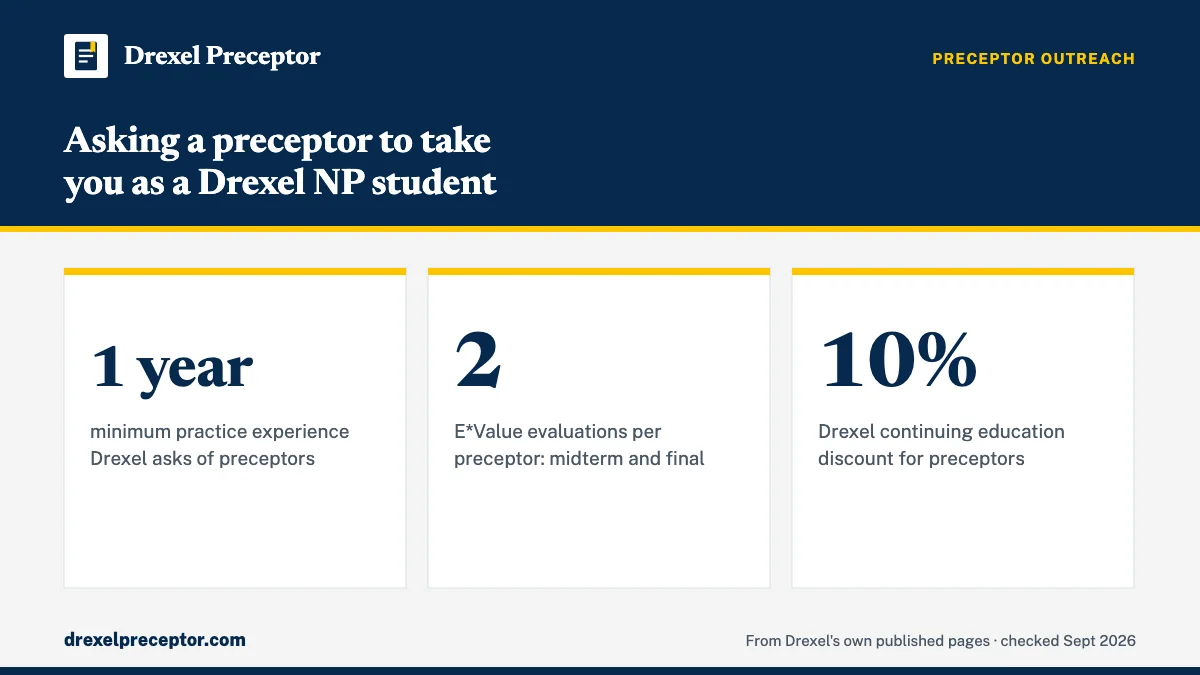
A good ask answers a clinician's questions before they raise them: which Drexel course, how many hours and when, what Drexel needs from them and what they get back. Drexel's side is short and concrete. A preceptor sends three documents, fills in two E*Value evaluations, signs off on your hours, and can call themselves Clinical Faculty at Drexel for as long as they precept.
Want us to make the ask?
Tell us your track, course and term. A placement advisor replies with how we'd approach preceptors near you on your behalf.
Quick facts
- Who can precept
- An NP, CNM or physician in an approved specialty
- Preceptor sends
- CV, state license and board certification
- Preceptor's E*Value tasks
- Midterm and final evaluations; validate your hours
- Drexel gives back
- Clinical Faculty title, hours certificate, CE discount
Check the fit before you ask
Asking the wrong person costs a week you may not have. Drexel takes three kinds of preceptor: nurse practitioners, certified nurse midwives, and physicians whose specialty Drexel approves. Whoever it is must hold the license and certification their own state requires, have practiced for at least a year and keep board certification current. Physician assistants don't appear on Drexel's list.
Then match the course. FNP courses call for family and primary care; AGACNP students train across medical, surgical and critical care units; WHNP courses move from gynecology to low-risk and then high-risk obstetrics. Drexel sets no public minimum of hours per preceptor and no published rule on relatives or employers, so raise those with your track director before approaching someone at your own workplace. Details are on Drexel preceptor requirements.
What to put in your first message
Keep it to one screen. Cover:
- Program and course. Name it the way Drexel does, such as
NURS 534in the FNP sequence, or the four-digit semester number for courses from Fall 2027. - Dates and hours. The term dates and the hours the course needs. Most quarter clinical courses are 160 hours over ten weeks; Drexel says AGACNP students typically do two eight-hour days a week.
- What Drexel asks of them. Their CV, license and board certification before the term; during it, one evaluation at midterm and one at the end, both in E*Value, plus confirming your logged hours there.
- What Drexel gives back. Use of the Clinical Faculty title, a Certificate of Appreciation each term showing the hours they verified, and 10 percent off Drexel's continuing education programs.
- Your readiness. That you're working through Drexel's compliance clearance: background checks, drug test, immunizations, AHA BLS and health insurance.
- The next step. A request for the name of whoever signs student agreements, so Drexel's clinical contracting can start.
Attach a one-page CV of your own. It helps a clinician picture you in their clinic.
A sample first message
Adapt this rather than sending it as written; one sentence on why you want their practice in particular does more than any template.
“Dear [name], I'm a Drexel University FNP student looking for a preceptor for NURS 535, which runs [dates] and needs 160 clinical hours. Drexel welcomes NPs, midwives and physicians in approved specialties once they've practiced for a year and hold current board certification. You'd share your CV, license and board certification, then complete two short evaluations and confirm my hours in E*Value. In return, Drexel gives you the Clinical Faculty title while you precept, a certificate of your hours each term and a discount on its continuing education. I've worked [your nursing background] and would value learning in your practice. Could we talk for ten minutes this week?”
Send it by email or through the practice's own contact route, and follow up once after a week if you hear nothing.
When the answer is yes
Move while the yes is fresh. Gather the three documents Drexel reviews (CV, license, board certification) and ask who handles student agreements at the site; that person often isn't your preceptor. Drexel's CNHP Contracts and Compliance team handles the clinical affiliation agreement through the contracting process introduced in NUPR 520.
Ask the site about its own onboarding as well: badge, EHR access, orientation modules, extra clearances. Older Drexel handbooks put contract processing at three to eight weeks, and Drexel publishes no current turnaround, so pass the site contact on straight away rather than letting a committed preceptor wait on paperwork. The contract side is on the affiliation agreement page.
Keep your preceptor posted as each step clears. A clinician who hears nothing for weeks may give those clinic days to someone else.
When the answer is no, or silence
A no is still useful if you ask one more question: who else might take a Drexel student? A name from inside a practice lands better than another cold message.
Former Drexel students report that persistence pays off, cold calls included, and that starting a year out isn't too early. Drexel's own tools widen the net. Dragon Network lets you message Drexel-affiliated clinicians who have volunteered to precept, and Drexel's clinical placement manager recruits preceptors for the department.
Some large systems route every request through the school. CHOP, for one, tells students not to approach its clinicians or departments on their own. Read a system's student placement page before you email one of its clinicians.
Why students hand the outreach to us
Outreach is where searches tend to stall, and it's the part we do best. A placement advisor contacts preceptors on your behalf with a Drexel-specific brief: your course number, hours and dates, Drexel's preceptor rules, the E*Value duties and what Drexel offers in return. Clinicians get a clear, complete ask, and you get answers sooner.
When someone says yes, we gather their credentials, confirm they fit Drexel's rules for your population, and pass you the name of whoever signs for the site so Drexel can start the agreement. Drexel approves every preceptor, and the credentials it sees from us are complete and checked against its list. If a preceptor drops later, we're back on outreach for you. Start your search.
Questions Drexel students ask
Does Drexel pay its NP preceptors?
Drexel's preceptor page describes recognition, not payment. Preceptors can use the Clinical Faculty title while they supervise you, receive a Certificate of Appreciation each term listing the hours they verified, and get 10 percent off Drexel's continuing education programs. No stipend is described. If a clinician asks about payment, point them to that page and your track director.
Can I contact CHOP preceptors directly for a Drexel rotation?
No. CHOP's placement page routes graduate requests through the school's clinical site coordinator, using CHOP's own request form, and tells students to leave its clinicians and departments alone until then. CHOP also wants an affiliation agreement in place and a Pennsylvania or New Jersey license. Ask Drexel how CHOP requests work for your track.
How far ahead should I ask a preceptor?
Drexel publishes no deadline for naming a preceptor. Its sample plans schedule NUPR 520, the seminar that introduces contracting and compliance, roughly three terms ahead of the first clinical course, and older handbooks put contract processing at three to eight weeks. Asking several months ahead leaves room for the agreement, onboarding and a backup if the first yes falls through.
What if a preceptor asks for a Drexel preceptor agreement form?
Drexel's current form names aren't public. Older Drexel handbooks mention a Preceptor Agreement Form sent to the student before the rotation, but that came from a non-NP handbook. Tell the preceptor Drexel sends what it needs once the site and preceptor are submitted, and ask Clinical Compliance or your track director which forms apply now.
Can someone at my own workplace precept me?
Drexel's public pages are silent on precepting where you're employed or by someone who manages you. Ask your track director before you approach a colleague. If it's allowed, keep the clinical hours clearly separate from your paid shifts so there's no question about what your preceptor validates in E*Value.
Related pages
Last checked 2026-09-24
We check these pages against Drexel's own sources. Your track director, the CNHP Clinical Compliance team and Drexel's current catalog have the final word.
Hand us the search. Keep your clinical quarter.
Tell us your Drexel track, where you live and which quarter your next clinical course starts. We find a preceptor and site that fit Drexel's rules for your track, and get the contract and compliance details ready early.
- Matched to your track's population, setting and hours
- Checked against Drexel's preceptor rules before anything is submitted
- Planned across the Fall 2027 switch to semesters
Start your placement plan
A placement advisor replies with what a Drexel-ready preceptor and site look like for you.